



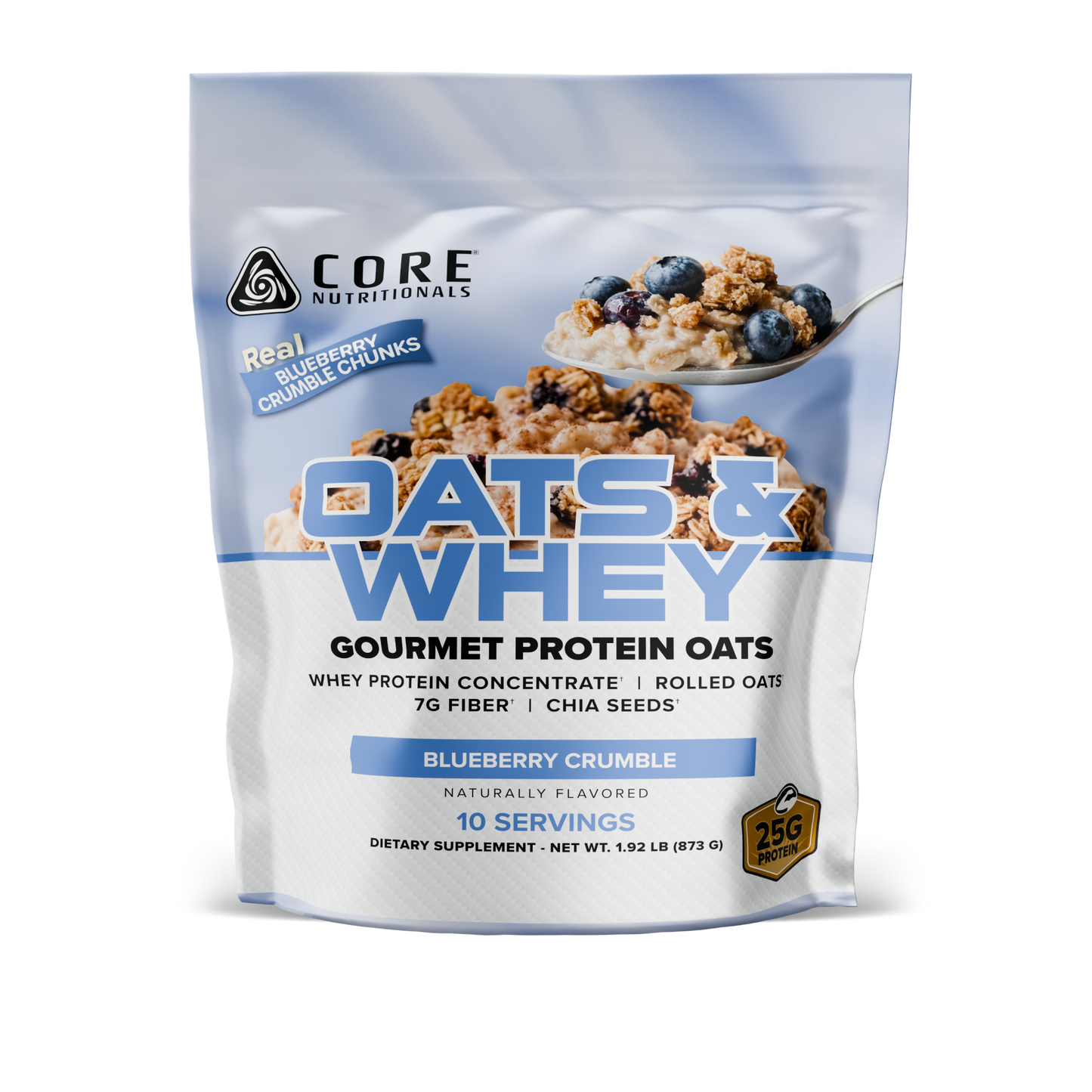
Oats & WheyGourmet Protein Oats
Oats & Whey
Free Domestic Shipping on Orders Over $150



ROLLED OATS & WHEY PROTEIN CONCENTRATE
-
Rolled Oats
Oats have long been considered one of nature's perfect carbohydrates. Rich in complex carbohydrates and fiber, rolled oats provide sustained energy to help fuel everyday activities, support training performance, and keep you feeling fuller for longer.
Unlike simple sugars that can cause rapid spikes and crashes in energy, the carbohydrates found in oats are slowly digested, helping provide a steady release of fuel throughout the morning. Oats are also naturally rich in important micronutrients and contain beta-glucans, a type of soluble fiber that has been extensively researched for its ability to support heart health and overall wellness.
Whether consumed before training, after training, or simply as part of a balanced breakfast, rolled oats provide the perfect foundation for a premium meal.
Cold-Processed Undenatured Whey Protein Concentrate
Whey protein concentrate is widely known as one of the highest quality protein sources available. However, how the protein is processed makes all the difference.
Through cold processing and minimal denaturation, the natural structure of the protein is preserved, helping maintain the integrity of the amino acids and beneficial protein fractions. Whey protein concentrate provides all essential amino acids and is particularly rich in branched-chain amino acids, including leucine, which plays a critical role in stimulating muscle protein synthesis.
Its rapid digestion and exceptional bioavailability make whey protein concentrate an ideal protein source for athletes and active individuals looking to support muscle recovery, lean muscle growth, and overall performance.
By combining premium whey protein with quality carbohydrates from oats, Oats & Whey provides a balanced meal that can help support recovery and keep you fueled between meals.
Coconut Oil Creamer
Great nutrition should never come at the expense of flavor. To elevate both taste and texture, we've included a premium coconut oil creamer. This addition provides a rich, creamy mouthfeel that transforms every serving into a truly indulgent experience.
Medium-chain triglycerides (MCTs) found naturally in coconut oil are rapidly utilized by the body and have been widely studied for their role in energy metabolism. In addition to helping create an incredibly smooth consistency, coconut oil contributes to the satisfying experience that makes Oats & Whey feel more like a gourmet breakfast than a typical functional food.
Premium Inclusions
Anyone can flavor a protein product. Very few brands are willing to go the extra mile and incorporate real premium inclusions that create a true experience.
At Core Nutritionals, we believe that eating healthily shouldn't feel like a punishment. That's why every flavor of Oats & Whey is loaded with carefully selected inclusions designed to deliver incredible taste and texture in every bite.
Whether it's fruit pieces, chocolate chips, peanut butter chips, or other decadent additions, these premium inclusions elevate Oats & Whey far beyond ordinary oatmeal.
Let's be honest—if healthy food tastes amazing, consistency becomes easy.
Chia Seeds
Chia seeds have earned their reputation as a nutritional powerhouse. Naturally rich in fiber, omega fatty acids, and essential minerals, chia seeds provide added nutritional value while contributing to the thick, satisfying texture that makes Oats & Whey so enjoyable.
Their ability to absorb liquid helps create a creamy and thick consistency while also supporting satiety, making Oats & Whey a filling meal that can help curb cravings and keep you satisfied for hours.
REFERENCES
- Whitehead A, Beck EJ, Tosh S, Wolever TM. Cholesterol-lowering effects of oat β-glucan: a meta-analysis of randomized controlled trials. American Journal of Clinical Nutrition. 2014;100(6):1413-1421.
- Rebello CJ, O'Neil CE, Greenway FL. Dietary fiber and satiety: the effects of oats on appetite control. Nutrition Reviews. 2016;74(2):131-147.
- Wood PJ. Cereal β-glucans in diet and health. Journal of Cereal Science. 2007;46(3):230-238.
- Thies F, Masson LF, Boffetta P, Kris-Etherton P. Oats and CVD risk markers: a systematic literature review. British Journal of Nutrition. 2014;112(S2).
- Tang JE, Moore DR, Kujbida GW, Tarnopolsky MA, Phillips SM. Ingestion of whey hydrolysate, casein, or soy protein isolate: effects on mixed muscle protein synthesis at rest and following resistance exercise. Journal of Applied Physiology. 2009;107(3):987-992.
- Tipton KD, Elliott TA, Cree MG, Wolf SE, Sanford AP, Wolfe RR. Ingestion of casein and whey proteins result in muscle anabolism after resistance exercise. Medicine & Science in Sports & Exercise. 2004;36(12):2073-2081.
- Phillips SM. The impact of protein quality on the promotion of resistance exercise-induced changes in muscle mass. Nutrition & Metabolism. 2016;13:64.
- Morton RW, Murphy KT, McKellar SR, et al. A systematic review, meta-analysis and meta-regression of protein supplementation on resistance training-induced gains in muscle mass and strength. British Journal of Sports Medicine. 2018;52(6):376-384.
- Cermak NM, Res PT, de Groot LC, et al. Protein supplementation augments the adaptive response of skeletal muscle to resistance-type exercise training. American Journal of Clinical Nutrition. 2012;96(6):1454-1464.
- St-Onge MP, Jones PJH. Physiological effects of medium-chain triglycerides: potential agents in the prevention of obesity. Journal of Nutrition. 2002;132(3):329-332.
- St-Onge MP, Bosarge A. Weight-loss diet that includes consumption of medium-chain triglyceride oil leads to greater rate of weight and fat mass loss than olive oil. American Journal of Clinical Nutrition. 2008;87(3):621-626.
- Mumme K, Stonehouse W. Effects of medium-chain triglycerides on weight loss and body composition: a meta-analysis of randomized controlled trials. Journal of the Academy of Nutrition and Dietetics. 2015;115(2):249-263.
- Kasai M, Nosaka N, Maki H, et al. Effect of dietary medium- and long-chain triacylglycerols on body fat accumulation in healthy humans. Asia Pacific Journal of Clinical Nutrition. 2003;12(2):151-160.
- Ulbricht C, Chao W, Nummy K, et al. An evidence-based systematic review of chia seed (Salvia hispanica) by the Natural Standard Research Collaboration. Reviews on Recent Clinical Trials. 2009;4(3):168-174.
- Vuksan V, Jenkins AL, Brissette C, et al. Salba-chia supplementation and cardiovascular risk factors in type 2 diabetes. Diabetes Care. 2007;30(11):2804-2810.
- Muñoz LA, Cobos A, Diaz O, Aguilera JM. Chia seed (Salvia hispanica): an ancient grain and a new functional food. Food Reviews International. 2013;29(4):394-408.
- Capitani MI, Spotorno V, Nolasco SM, Tomás MC. Physicochemical and functional characterization of chia seed proteins and oil. Journal of the American Oil Chemists' Society. 2012;89:79-85.
- Jäger R, Kerksick CM, Campbell BI, et al. International Society of Sports Nutrition Position Stand: Protein and Exercise. Journal of the International Society of Sports Nutrition. 2017;14:20.
- Phillips SM, Van Loon LJC. Dietary protein for athletes: from requirements to optimum adaptation. Journal of Sports Sciences. 2011;29(S1).
- Moore DR, Churchward-Venne TA, Witard O, et al. Protein ingestion to stimulate myofibrillar protein synthesis requires greater relative protein intakes in healthy older versus younger men. Journals of Gerontology Series A. 2015;70(1):57-62.
- Morton RW, Traylor DA, Weijs PJM, Phillips SM. Defining anabolic resistance: implications for delivery of clinical care nutrition. Current Opinion in Critical Care. 2018;24(2):124-130.
-


Game changer now I don't have to add protein powder to my oatmeal